Copyright or Trademark: Which One Takes a Fake Down?
Use copyright when a copy takes something you made, like your photos or text. Use trademark when it uses your name or logo. Many fakes are both. How to choose.
Use copyright when a copy takes something you made, such as your product photos, your description or your artwork, and use trademark when it uses your brand name or logo to pass itself off as you. A true counterfeit, a product carrying your mark, is a trademark case, but most fake listings also use your photographs, so most small brands have both rights in play and should lead with whichever is easier to prove.
That's the short answer. The longer one matters, because picking the wrong right is how a strong case turns into a rejected report.
What's the difference, in one sentence each?
Copyright protects things you made. Trademark protects the signs that tell buyers the thing came from you.
Put them to work and they ask different questions. Copyright asks: is this your picture? Trademark asks: will a buyer think this is you?
The first question has a yes-or-no answer you can usually see with your own eyes. The second is a judgement about confusion, and judgements take longer.
When does copyright do the job?
More often than small brands expect.
US law gives copyright to original works of authorship fixed in a tangible medium. Your product photographs, your listing text, your illustrations, your packaging artwork: all of it is protected from the moment it exists. You don't register anything to own it, and you don't need a registration to send a takedown notice.
Picture two listings. One shows a plain, unbranded copy of your product, photographed in your studio, with your words underneath. The other shows a stranger's photo of a product printed with your logo. The first one is a copyright case. You can prove it by putting your original next to theirs. The notice process is set out in section 512 of the Copyright Act, and if you want to write a DMCA takedown notice yourself, there's a template with each required element. I write the guides at Brand Protection Tools.
There's a limit, and it's an important one. Copyright never protects an idea, a procedure, a system or a method. It won't stop someone selling a product that does what yours does, or one that simply looks like yours. It protects your expression of the product, the photo and the words, not the product.
When do you need the trademark?
When the copy carries your name.
A counterfeit, in the strict sense, is a product bearing a mark that copies yours. US law defines a counterfeit mark as a counterfeit of a mark registered on the Principal Register for the same goods. The core test for trademark infringement is whether the use is likely to cause confusion, or to cause mistake, or to deceive.
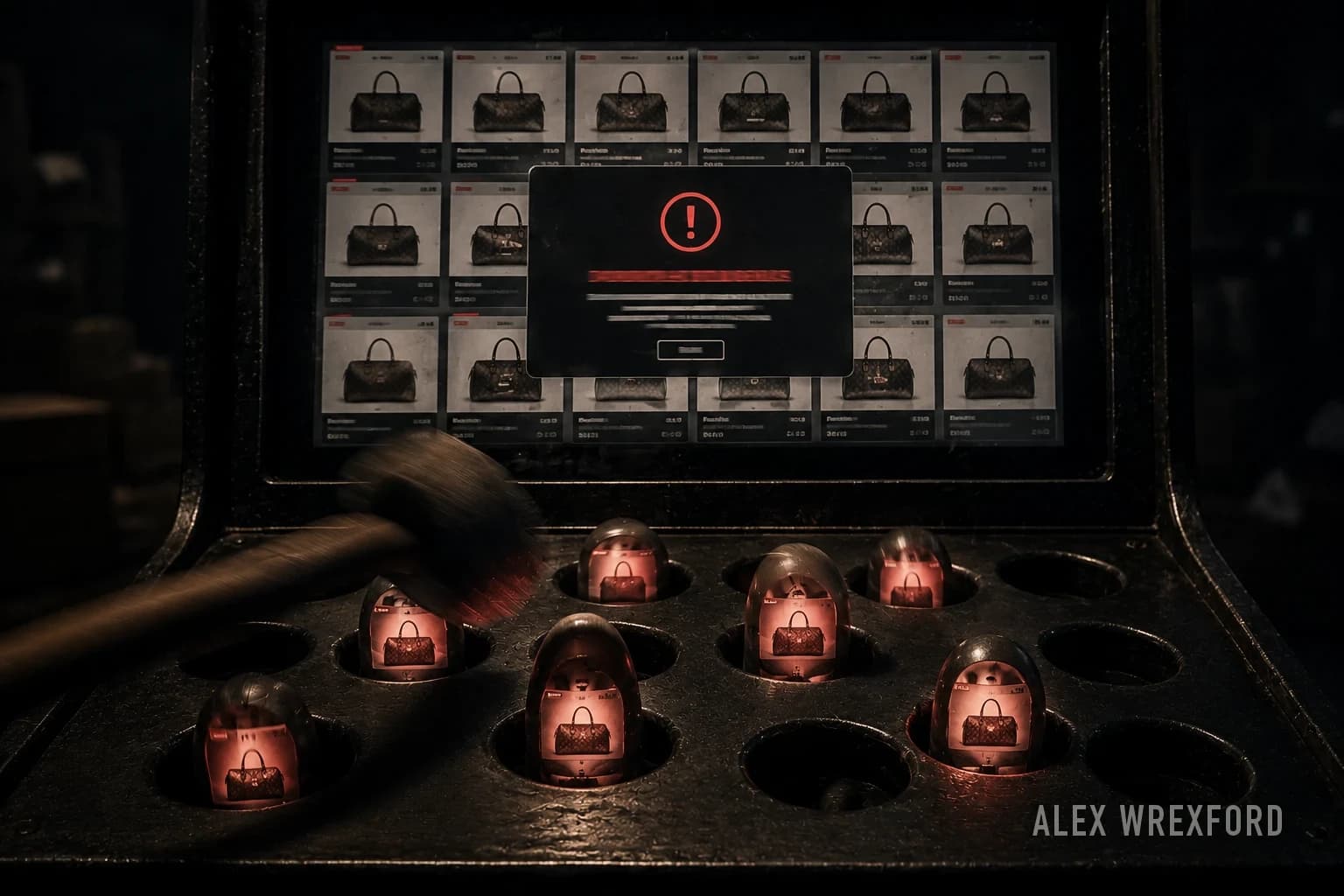
That registration requirement is why the trademark matters for the worst cases. A superfake handbag, the kind I wrote about in superfakes explained, may arrive with no stolen photos at all. The seller shot their own. The only right that touches it is the trademark on the bag.
A registration also brings the heavy remedies. For counterfeits, a US court can award statutory damages of $1,000 to $200,000 per counterfeit mark per type of goods, and up to $2,000,000 if the use was wilful. Copyright's statutory damages, by comparison, run from $750 to $30,000 per work, or up to $150,000 if wilful. Both sets of numbers belong to lawsuits, not takedown notices, but they're why lawyers ask about registrations first.
Why does the choice change what happens next?
Because the two rights run on different rules after you file.
The DMCA's process, including the counter-notice and the clock of 10 to 14 business days before a platform restores a listing, is a copyright rule. It doesn't apply to trademark complaints. Those run on each platform's own policy. Etsy, for example, says it accepts counter-notices only for US-based copyright reports.
So the right you choose decides the kind of fight you might get. A copyright notice can be answered with a counter-notice, and then you're on a statutory timetable that ends in court or in reinstatement. A trademark complaint leaves the platform to decide under its own terms.
Neither is better in the abstract. But it's worth knowing which game you've started before the seller replies.
What if the copy takes your design, not your logo?
Then neither of the two big rights may fit, and this is where small brands get hurt.
A product's useful shape isn't protected by copyright. The Supreme Court made that plain in a case about cheerleading uniforms: a designer can protect the artwork on the surface, but not the right to stop anyone making a uniform of the same shape, cut and dimensions. A trademark won't help either unless the copy carries your name or your design has become a recognised sign of your brand.
The tool built for this is the design patent. US law allows a patent for any new, original and ornamental design for an article of manufacture, and it lasts 15 years from the date it's granted. It's slower and costlier than the other two and you have to apply before you need it. For a brand whose value sits in a distinctive product shape, it's worth a conversation with a patent attorney before launch, not after the first copy.
What does each right cost to hold?
Less than most people assume, and the gap between them is the real argument.
Copyright costs nothing to own. If you want the option of suing in the US, registration is $45 for a single work by one author, $65 for a standard application, and $55 for a group of photographs. That's the whole bill for the right you'll use most.
A trademark is a bigger commitment. The USPTO charges $350 per class of goods for an application, before any lawyer's fee. In the UK, the government's own guidance says registering a trade mark costs at least £205. Most small brands need one or two classes, not ten.
So the cheap right is the one you already have, and the expensive one is the one that reaches the counterfeit itself. I'd hold both. Use copyright this week, and file the trademark this month, because a pending application already opens doors on some platforms.
So which should you lead with?
The one you can prove fastest.
My rule of thumb: if the listing uses your photos or text, lead with copyright, because you can prove it in one screenshot and you already own it. If it carries your registered mark on the product itself, use the trademark, because that's the right that reaches the counterfeit and not just the advert for it. If it does both, file on the one with the clearest evidence and keep the other in reserve.
And if you're still unsure where your brand stands, Brand Protection Tools has a plain-English explainer of what brand protection covers. Its software prepares a copyright notice when your photos were used and a trademark complaint where you hold a trademark, which is the same split this piece describes.
Spotting the copy is the first job. How to spot a counterfeit covers the tells in the listing and in the parcel. I follow the trademark cases all the way to the courtroom in The Takedown.
Sources
- 17 U.S.C. 102(a) and (b), subject matter of copyright and the exclusion of ideas, procedures, systems and methods: https://www.law.cornell.edu/uscode/text/17/102 (checked 7 November 2026)
- 17 U.S.C. 512, notice and takedown and counter-notice: https://www.law.cornell.edu/uscode/text/17/512 (checked 7 November 2026)
- 17 U.S.C. 504(c), copyright statutory damages: https://www.law.cornell.edu/uscode/text/17/504 (checked 7 November 2026)
- 15 U.S.C. 1114(1), use likely to cause confusion, mistake or deception: https://www.law.cornell.edu/uscode/text/15/1114 (checked 7 November 2026)
- 15 U.S.C. 1116(d)(1)(B), definition of a counterfeit mark: https://www.law.cornell.edu/uscode/text/15/1116 (checked 7 November 2026)
- 15 U.S.C. 1117(c), statutory damages for counterfeit marks: https://www.law.cornell.edu/uscode/text/15/1117 (checked 7 November 2026)
- 35 U.S.C. 171 and 173, design patents and their 15-year term: https://www.law.cornell.edu/uscode/text/35/171 (checked 7 November 2026)
- US Copyright Office fee schedule: $45, $65 and $55 group of photographs: https://www.copyright.gov/about/fees.html (checked 7 November 2026)
- USPTO fee schedule: base application $350 per class: https://www.uspto.gov/learning-and-resources/fees-and-payment/uspto-fee-schedule (checked 7 November 2026)
- GOV.UK, register a trade mark: "costs at least £205": https://www.gov.uk/how-to-register-a-trade-mark/apply (checked 7 November 2026)
- Star Athletica, L.L.C. v. Varsity Brands, Inc., No. 15-866 (US Supreme Court, decided 22 March 2017): https://www.supremecourt.gov/opinions/16pdf/15-866_0971.pdf (checked 7 November 2026)
- Etsy, Intellectual Property Policy (last updated 29 October 2026): https://www.etsy.com/legal/ip (checked 7 November 2026)
Key takeaways
- Copyright asks: is this your picture? Trademark asks: will a buyer think this is you?
- Copyright is automatic and cheap to use. A trademark costs money but reaches the counterfeit product itself.
- The DMCA and its counter-notice clock apply to copyright only. Trademark complaints run on each platform's own policy.
- When a listing uses both your logo and your photos, lead with the right that's easiest to prove.