How to Spot a Counterfeit: What Investigators Actually Check
The signals investigators check to spot a fake: listing and price, the parcel and paperwork, and the physical teardown. Practical, honest, no certainty.
If you want the short version, here it is. The strongest signals come before the product is even in your hands: a price that's too good, a seller who behaves oddly, a listing that borrows someone else's photos. Once it arrives, you check the physical tells, weight, stitching, materials, date codes, security features, and you look for a cluster of wrong notes rather than one smoking gun. None of it gives certainty. Authentication is a probability game, and anyone who tells you otherwise is selling something.
I've spent years pulling fakes apart, and the thing that surprises people is how little of the work happens at the dramatic moment, the tape getting slit and the counterfeit held up to the light. By then I usually already know. Here's what actually gets checked, in the order a careful person checks it.
The listing and the price
The first tell is the one you can read for free, before you spend a penny. A price that sits well below the genuine article isn't a bargain, it's a confession. Real goods have a floor, set by what they cost to make and what the brand will tolerate. When a listing breaks that floor by a mile, the most likely explanation is that the thing isn't what it claims to be.
Then read the seller like you'd read a room. A storefront that went live last week, sells one product, and uses a photo lifted straight off the brand's own site is noise. What's harder to dismiss is a seller who looks like a real business but is priced like a fraud. Look at the description for the small wrongness: a broken phrase, an odd size chart, a product name that's a fraction off. The same flawed wording copied across "different" shops tells you they're one operator wearing several masks.
The clearest red flag of all is the nudge off-platform. A legitimate marketplace purchase runs through the marketplace's own protected payment rails, and that's clean and boring. A counterfeiter often messages you after you've shown interest, suggesting a bank transfer for "a better price" or payment to an account whose name has nothing to do with the shop. That nudge is the seller telling you the shopfront is a front and the real business is somewhere they control. For a buyer, it's a reason to walk. For an investigator, it's the thread that leads home.
The parcel and the paperwork
When the parcel lands, the work starts on the outside, not the inside. I photograph it sealed and I read it before I open it, because the packaging is a document written by someone who didn't realise they were writing one.
Start with the return address. A blank one on an international parcel is a choice, and choices are evidence. An address that doesn't match the storefront is a second identity to chase. A suite number that turns out to be a shared mailbox used by forty other sellers is a hub, and a hub ties supposedly separate shops into one supply chain.
Then the routing and the customs declaration. A parcel that claims to ship from one country but carries another country's postal markings has just told you about a transhipment route, the laundering of a parcel's history before it reaches you. The customs form is the gift counterfeiters are worst at faking. They undervalue, to dodge duty and inspection, and they mislabel, calling a branded jacket a "no-brand polyester sample" worth eight dollars. Every lie there is dated, signed through a postal system, and useful.
For an ordinary shopper, you won't be pulling carrier records. But you can still notice the basics: a mismatch between where it claimed to ship from and where it actually came from, a wildly undervalued customs slip, packaging that looks nothing like a brand that charges a premium would ever send. Operations that run at volume develop habits, the same mailer, the same crooked label, the same hand-torn tape, because habits are efficient and efficiency is how they make money. Those habits are how I match storefronts to each other. For you, they're a sign you're dealing with a bulk faker, not a retailer.
The teardown: physical tells
Now the product. A good authenticator runs the senses before any instrument comes out of a drawer, and that first pass is a database built over years of how the genuine thing feels.
Weight first. A fake of a high-end item is usually lighter, because the hardware is thinner, the materials cheaper, the lining flimsier. You learn the heft of the real thing and the lie announces itself by being wrong. Then the materials: genuine full-grain leather has an irregular natural texture and a particular smell, while fakes read smoother, flatter, slightly plasticky, and smell of chemicals because they often are chemicals.
Stitching used to be where fakes fell apart, longer, thinner, wandering stitches in the wrong shade of thread. On a real item the stitch is even, dense, and a specific colour. I say "used to" because the best fakes now copy stitch count and thread colour strand for strand. The heat stamp or embossed logo is another old reliable: on the genuine article it's centred, deep, even, crisp, and on a lot of fakes it's shallow and drifting off-centre. Fonts in general are a graveyard for counterfeiters. The kerning is wrong, a curve too round, a serif off. The brain that grew up seeing the real logo registers the wrongness without being able to name it.
Then the quieter tells. Date codes catch people out, because the readable code stamped inside changes format over the years, and a code in the wrong format for its claimed era is a fake no matter how clean the digits. That's contextual knowledge, it lives in the authenticator's head, not on the product where it can be copied. Security features are the same arms race: a hologram only tells you someone applied a hologram, not that they were allowed to. The serious version is the embedded chip that answers from the brand's own database, harder to clone because faking it means faking an entry in a system you don't control.
Here's the uncomfortable part. Every tell I've just listed is public. Every authentication guide online lists the mustard thread and the centred stamp, and counterfeiters read those guides too. Every tell that gets written up gets fixed in the next production run. So the reliable signals have migrated to what's expensive or contextual to fake: the metal under the plating, the void inside a casting, the smell of the wrong adhesive a photo will never carry. The surface is the easy thing. Stop trusting the surface.
When in doubt
People always ask whether a machine can just settle it. Point, scan, real or fake, done. The honest answer is sometimes, and never on its own.
A scanner that captures hundreds of microscopic images and compares them against a database is genuinely brilliant at volume and consistency. It doesn't get tired on the four-hundredth item, it doesn't wave something through because the seller was charming, and it catches material signatures a human eye can't resolve. For a resale platform processing thousands of items, that's a real answer to a real problem. But a model is only as good as what it's seen. It's superb when the fake is wrong in a way the database has catalogued and much weaker when the fake is right in every way it checks and wrong in a way it doesn't. A trained human knows this model never shipped in this colourway, smells the wrong glue, and gets unsettled by a wrong note they can't yet name. Machine for the haystack, human for the needle. That pairing is the actual state of the art, and the gap is closing every year.
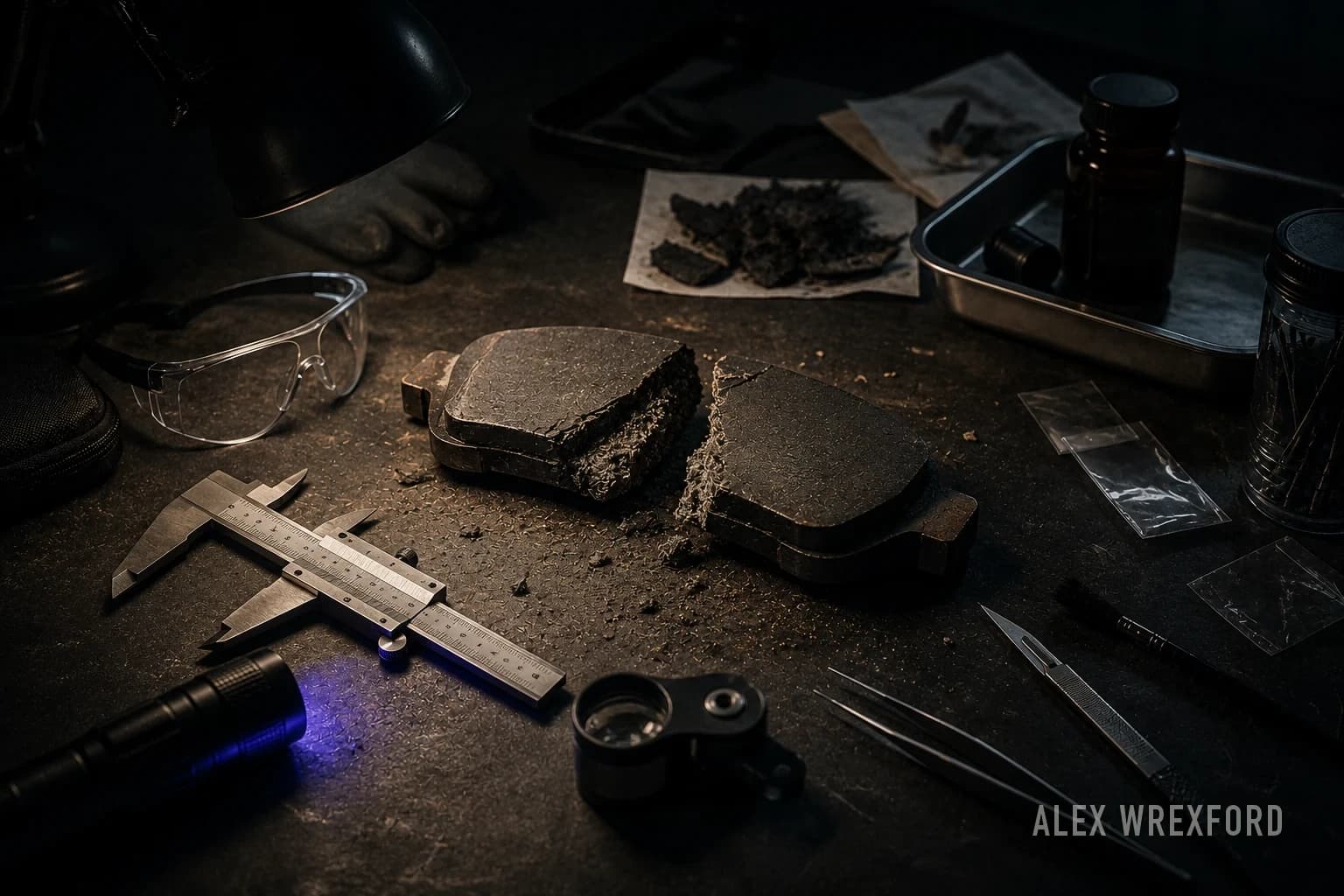
For you, as a buyer, the practical version is simpler. Be most suspicious when several small things are off at once, the price and the seller and the packaging and a tell on the product. One oddity might be nothing. A cluster is a pattern. And if it's a category where a fake can hurt you, medicines, electrical goods, car parts, treat doubt as a stop sign, not a discount. A fake handbag costs you money and pride. A fake brake pad costs something you can't refund.
I can't give you certainty here, because there isn't any. The best operations in the world work in probabilities, and so should you. What I can tell you is that the people who get fooled almost always ignored a signal they'd already noticed, the price that was too good, the seller who wanted paying off the books. The truth was usually there before they opened the box.
This piece draws on the test-buy and teardown chapters of my book The Takedown, which goes a lot deeper into how the people behind the fakes get caught.
Key takeaways
- Most of the verdict comes before you touch the product: the price, the seller, and the listing carry the strongest early signals.
- No single tell is proof. Authentication is probabilistic, a cluster of wrong notes, not one smoking gun.
- Counterfeiters have won the surface, the logo, the stitch, the photo, so the reliable tells have moved to weight, materials, and security features that are expensive to fake.
- A machine is great for the haystack and a trained human is still ahead on the needle, the contextual fake that's technically perfect but wrong about the world it claims to come from.