Superfakes Explained: How Mirror-Grade Counterfeits Fool the Experts
What a superfake is, why mirror-grade fakes fool authenticators, and how the makers and resellers actually get caught. A plain guide.
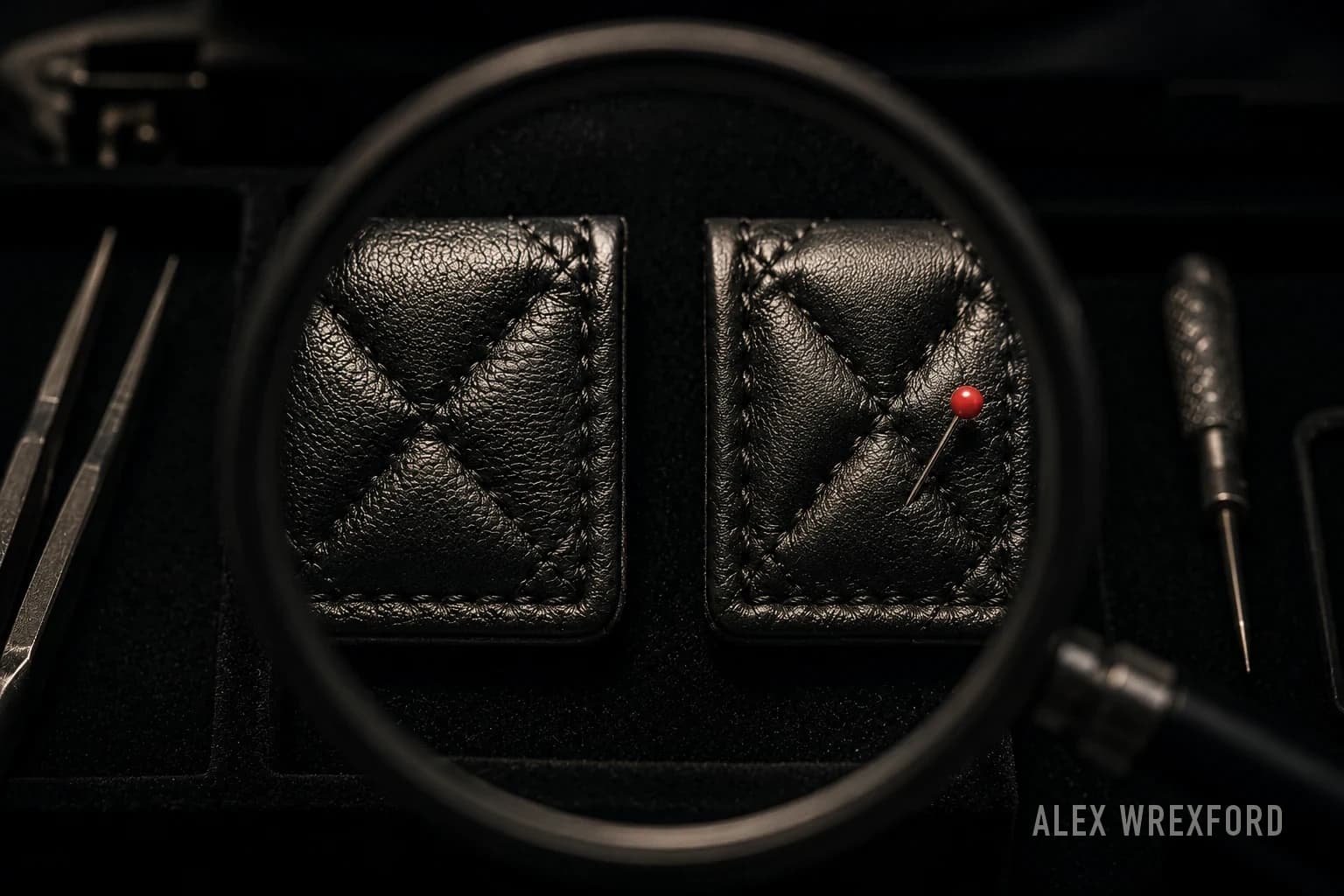
A superfake is a counterfeit luxury item, almost always a handbag, made to a standard high enough that experienced buyers and even some professional authenticators struggle to tell it from the real thing. The word went mainstream in May 2023, when the New York Times Magazine ran Amy X. Wang's feature "Inside the Delirious Rise of 'Superfake' Handbags." The detail that made people sit up: wealthy buyers who can easily afford the genuine item buy the replica anyway, on purpose, because it's that good.
That inverts the usual moral story of fakes. The familiar version is a poor shopper deceived into buying rubbish. The superfake version is a rich shopper choosing, eyes open, a thing they know is fake because it's indistinguishable from the thing that costs ten times more. The deception hasn't gone, it's just moved off the buyer and onto everyone the buyer will ever meet.
What does "mirror grade" mean?
The trade grades itself, with confidence it hasn't earned. On the forums and messaging apps where these things change hands, you'll see "1:1" and "mirror," or "mirror quality," thrown about like certifications. They aren't. They're seller claims. A mirror-grade bag is one the seller wants you to believe is a perfect reflection of the original. Sometimes it nearly is. Often it isn't. The label tells you what the seller is reaching for, not what's in the box.
The geography is no mystery. Coverage lands again and again on southern China, and on Guangzhou in particular, named repeatedly as the replica-handbag capital, with the Baiyun leather goods wholesale market named as the largest hub. US Customs and Border Protection puts it bluntly: roughly 70 percent of counterfeits seized at the US border originate in China and Hong Kong.
Here's the number that turns a hustle into an industry. Sarah Davis, who runs the resale platform Fashionphile, says some counterfeit Birkins now sell for "$6,000 plus, handmade." For a fake. Two decades ago, she points out, the fakes went for about twenty-five dollars. A CBP director, Frank Russo, gave the reason: technology has made producing a superfake "easier now than ever before." And the scale is the kind headlines can't hold. Counterfeit goods are reckoned at about 2.5 percent of global trade, and in one cited fiscal year US authorities seized over 23 million items worth around two billion dollars. That's the part they caught.
How do you tell a superfake from the real thing?
Until recently there was a craft to this. Authenticators had tells, the small physical truths a factory copying from photographs got wrong.
Take Louis Vuitton, the most copied house on earth and so the most documented. The heat stamp sits centred and deep on the genuine article, every letter the same depth; on a fake it wanders, shallow and uneven. Real LV stitching uses thick waxed thread in a specific mustard-yellow, dense and boxy on the handles. The leather talks too: untreated Vachetta starts pale and patinas into honey over years, which a factory can't fake on day one because it's made of time. Genuine grain reads rich; fakes come up too smooth, plasticky. The hardware is heavier than it has any right to be, with vintage Chanel plated in 24-karat gold that throws a warm tone a thin electroplate can't match. And the date code, a stamped string you could decipher to place roughly where and when a bag was made.
Every one of those tells is now copied. Superfakes replicate the stitching, the hardware weight, the heat-stamp depth, the grain, the thread colour, and the part that should worry you most, the serial numbers. When the counterfeiter can clone the code meant to prove authenticity, the code stops proving anything. It becomes another surface to copy.
So the brands moved the proof somewhere harder to reach. Louis Vuitton discontinued the physical date code and embedded an RFID microchip; Chanel swapped serial stickers for chips, with reporting referencing chip-based and "blockchain-based" provenance. When the visible proof can be faked, you push it into a chip that talks to the brand's own database, somewhere the counterfeiter can't easily go.
Who's winning the authentication arms race?
The shape repeats. Authenticators find a tell. Counterfeiters copy it. Authenticators move to a harder layer. So verification keeps migrating away from the outside of the bag, which is exactly what the counterfeiter is best at, toward the things hardest to fake: internal structure, metallurgy, microscopic material signatures, and the brand's own record of what it actually made. Which is how authentication stopped being a craft and became a forensics lab.
Enter Entrupy, a handheld device paired with AI. Run it over an item and it captures more than 200 microscopic images, of monogram alignment, material grain, hardware engravings and wear patterns, then compares them against a database of known-authentic and known-counterfeit examples. The company says it returns a result in under about fifteen minutes, escalates uncertain cases to human experts, backs the verdict with a financial guarantee, and hits 99.86 percent accuracy. I'll be straight about that last figure: it's Entrupy's own number, not something independently audited in the sources I'm working from. Take it as a confident claim, not a verified fact. The method is the point. It looks at the bag the way a microscope looks at a fingerprint.
Resale platforms have gone into customs-lab kit. Reporting describes X-ray fluorescence analysers reading the metal composition of a clasp, because you can copy the colour and weight of gold without copying its elemental signature, and X-ray imaging to inspect internal structure, on the principle that the outside may be perfect but there can still be flaws inside. I won't pin which platform uses which instrument, because the clean source for that didn't survive the fact-check. At the artisanal end there's Volkan Yilmaz, who works as "Tanner Leatherstein," a Dallas-based leather expert who built a following buying designer bags and cutting them open on camera to see what the materials cost. One uses an X-ray, the other a scalpel. Both refuse to take the surface at face value.
So who's winning? On the visible layer, the counterfeiter. On the invisible layer, for now, the brands and the labs. Everything outside that line is increasingly theatre. Beautiful, expensive, six-thousand-dollar theatre.
How do the sellers get caught?
For all the microscopes and chips, the biggest superfake story of the lot came down to a storage unit.
In mid-November 2023, the US Attorney's Office for the Southern District of New York and Homeland Security Investigations announced what they called the largest-ever US seizure of counterfeit goods: roughly 219,000 items, with an estimated total manufacturer's suggested retail price of about $1.03 billion. Two men, Adama Sow, 38, and Abdulai Jalloh, 48, were arrested and charged with trafficking in counterfeit goods. Prosecutors alleged they ran the operation from a Manhattan storage facility from about January to October 2023.
Read that carefully. These are charges. Allegations. In the reporting I'm drawing on, neither man had been convicted of anything. An arrest is not a verdict, and a press release announcing a seizure is the start of a legal process, not the end of one. The brand-protection world has a bad habit of treating the day the handcuffs go on as the day justice is done. It isn't.
The seizure itself teaches the thing the microscope can't. Whatever the labs are doing, the supply behind them is industrial. You don't fill a Manhattan unit with a billion dollars of sticker-price fakes one mirror-grade Birkin at a time. Detection and volume are different problems, and solving the first does almost nothing to the second. You can build the best lie detector in the world. It doesn't reduce the number of liars.
So how do the makers actually get caught? Not by spotting the fake. By attribution and litigation. The clearest proof of that has nothing to do with handbags. It's a Danish company that makes little plastic bricks.
The copycat brand was Lepin, and you'd recognise the game instantly: the boxes looked like LEGO, the sets matched, the minifigures matched, and the whole thing sold for a fraction of the price. Per findings from the later criminal case, the operation began around 2015, with members buying genuine LEGO sets specifically to reverse-engineer them.
What LEGO did was push the case all the way through, across three separate legal tracks, and win on each. Civil copyright first: on 20 January 2020 the Guangzhou Intellectual Property Court upheld findings across 18 copyright cases and one unfair-competition case, ruled the sets and minifigures qualified as protected artworks, and ordered the defendants (Shantou Meizhi Model Co. and affiliates) to stop, to pay around 4.7 million yuan, and to publish public apologies.
Then the criminal track. On 23 April 2019, Shanghai police raided the operation and pulled out an inventory that reads like a factory audit: 603,875 products, 88 injection moulds, 289,411 boxes, 175,141 manuals and over 50,000 sales orders. On 2 September 2020 the Shanghai No. 3 Intermediate People's Court convicted nine individuals of copyright infringement. The principal defendant, identified in the reporting only by the surname Li, received six years in prison and a 90-million-yuan fine. Illegal turnover exceeded 330 million yuan, with nearly 4.25 million boxes sold across 634 models. The court called the circumstances "particularly serious." Then a third track, on trademark: on 1 April 2021 the Guangdong Higher People's Court raised damages tenfold, from 3 million yuan to 30 million, citing "obvious malicious infringement."
That's the lesson, and it's the opposite of the despairing one. Detection was never the wall. You don't have to win the argument about whether the bag is real. You have to win the argument about whether the people making it can be caught, named and made to pay. LEGO won that argument, in China, three times, by doing the slow, unglamorous attribution work first and feeding it to the people with the handcuffs. Almost nobody does that part, which is exactly why almost nobody gets this result.
Common questions
Is buying a superfake illegal? Laws vary by country, but the manufacture and sale of counterfeits is broadly illegal. The consumer-side legality differs by jurisdiction. This piece isn't legal advice; it explains how the trade and its enforcement work.
Why do rich people buy fakes they could buy real? Because the gap between a superfake and the genuine article has narrowed to the point where, on the visible product alone, the difference is hard to detect. The thing they can't buy in the fake is the brand's permission, the provenance record the brand controls.
Does a microchip make a bag unfakeable? No. Nothing is unfakeable. A chip moves the proof of authenticity into a record only the brand controls, which is harder to reach than anything printed on the outside of the bag. That's the point, not perfection.
What's the single biggest misconception about counterfeiting? That detection is the battle. It isn't. The reliable wins come from consequence, attribution and litigation pushed all the way through, not from a better scanner. See the glossary for definitions of superfake, mirror grade, authentication and teardown.
This is a notebook version of a longer story I tell in my book, The Takedown.
Key takeaways
- A superfake is a counterfeit good enough that experts struggle to tell it from the real thing. Buyers often know it's fake and buy it anyway.
- 'Mirror grade' is a seller's claim, not a certified standard.
- The visible tells (stitching, heat stamps, hardware, even serials) are now copied, so authentication has migrated to X-ray, AI microscopy and brand-controlled chip records.
- A single Manhattan bust seized roughly 219,000 items at about $1bn sticker price. Supply is industrial, not back-alley.
- The makers get caught through patient attribution and litigation, not through better lie detectors.