Why Do Takedowns Fail Against Counterfeiters?
Takedowns remove listings, not sellers. Here is why whack-a-mole enforcement loses, and what actually changes a counterfeiter's behaviour.
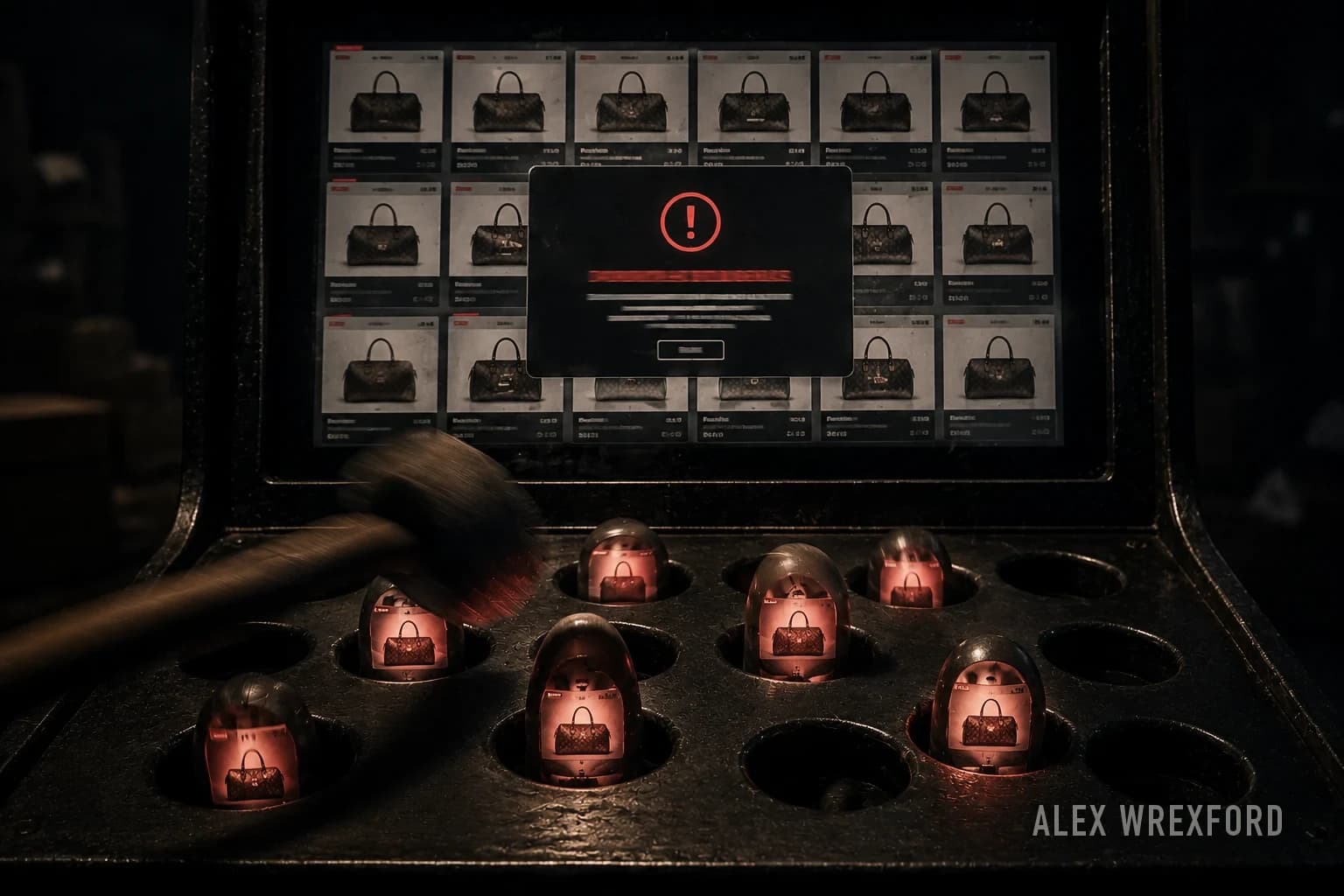
Short version: takedowns mostly don't work against counterfeiters, because a takedown removes a listing, not a seller. The person who posted it keeps everything that matters and relists within the hour. Counterfeiting is an attribution problem, not a volume one, and you cannot out-produce someone who can republish a fake for the cost of a few seconds of compute.
I've spent fifteen years watching people fight this with volume and lose, usually while a dashboard tells them they're winning. Here is why, and what works instead.
What a takedown actually removes
The word does a lot of dishonest work. A takedown sounds like an arrest. It is an administrative request, usually automated, asking a platform to remove a specific web page. The page is a listing. The listing is a row in a database. When the request succeeds, that row gets flagged removed and the page shows a polite "no longer available" message.
That's the whole event. Notice what didn't happen. Nobody was identified. No bank account was touched. No factory missed a shift. The person who made the listing sits exactly where they were five minutes ago, with the same stock, the same supplier, the same intent. You removed their advert. You did not remove them.
Think of a council that measures its graffiti response by counting how many tags it paints over. The number climbs every year, and every year there's more graffiti, because the kid with the spray can has never been found or fined. Painting over the wall isn't enforcement. It's maintenance, and you'll be doing it forever. A takedown is painting over the wall. (If the vocabulary here is new, the glossary defines takedown, burner listing, false positive, and notice-and-takedown.)
The burner-listing economy
To see why this is hopeless, look at the economics on the other side. They're brutal and they aren't symmetrical.
Picture one counterfeit operator running fakes of a popular trainer. They don't have one shop. They have hundreds. Each storefront is a seller account with a keyboard-mash name, a stock-photo face, and a registration tracing back to a mailbox, a shell, or a stolen identity. These accounts are disposable by design. The operator treats them like paper plates.
When a takedown lands, the operator doesn't mourn the listing. They open the next storefront, paste the same photos, the same description, the same price, and publish. The images were already in a folder. Increasingly it isn't even a person doing it; it's a script watching for suppressed listings and republishing across a rotating pool of accounts. I've seen relisting happen inside ten minutes.
Now the cost structure, because it's the whole game. A listing costs the counterfeiter pennies. Finding it, verifying it, documenting it, filing the notice and getting it removed costs the brand real money, a team, hours of review. Every round, the brand spends pounds and the counterfeiter spends pennies, and at the end of the round the counterfeiter is still selling. That isn't a war of attrition you can win. It's one designed for you to lose.
Worse, the seller treats your takedown as free market research. Every notice tells him which listings you found and which keywords trip your software. Your enforcement is teaching him to hide, and you're providing the lesson weekly.
When automated enforcement hits the wrong target
Here's the part that should genuinely annoy you. The volume model doesn't only fail to catch the guilty. It catches the innocent.
Automated systems enforce at a scale no human team could touch, so they set a threshold and let the software swing. Every classifier that swings makes two kinds of error: it misses things it should catch, and it catches things it shouldn't. You can tune down one only by raising the other.
Now think about who gets hit. The counterfeiter is an adversary, actively gaming the threshold, rotating storefronts, staying just under whatever the detector is tuned to. The legitimate seller is doing none of that. She's sitting still with a real product and one barcode field out of sync. She's the easiest thing on the page to flag, because she isn't trying to dodge anything. The machine optimises for cases closed, and a clean seller is a clean close.
The numbers back this up. In 2016, researchers Jennifer Urban, Joe Karaganis and Brianna Schofield published Notice and Takedown in Everyday Practice, drawn from a sample of over a hundred million notices sent in a six-month window. They read them by hand. Nearly a third, 28.4 percent, carried a characteristic that raised a real question about validity. And 4.2 percent, one in twenty-five, targeted content that flatly did not match the material the sender claimed was infringed. Scaled across the full set, that's roughly four and a half million notices, in six months, aimed at the wrong thing. Automated bulk senders accounted for a large share of the flaws.
That's the copyright side, where the data is richest. The marketplace side runs on murkier signals and the platforms don't publish their error rates, so we can't measure it directly. But it's the same plumbing, and the human cost is plainer: established sellers with near-perfect ratings knocked offline over a single flag, payouts frozen while they scramble to prove a negative against a verdict they can't read. The cost of error isn't symmetrical either. Wrongly suppress a real seller and you can take out a small business in a fortnight, because a founder on thin margins doesn't have eleven days of zero sales in the bank.
Why "listings removed" is the wrong metric
So why does anyone keep doing this? Because of the number. When you set up an enforcement team, the easiest thing to measure is listings removed. It's clean, it goes up, it fits in a board slide. "We removed forty-one thousand infringing listings, up nineteen percent." Everyone nods.
Here's the problem. Listings removed isn't a measure of how much counterfeiting you stopped. It's a measure of how much counterfeiting there was. A bigger number often means you're losing faster, because there's more fake product flooding the channel and your team is scooping more off the top.
Manage a team to that number and it gets perverse. Reward people for listings removed and they'll rationally chase the easy fakes a junior can verify in seconds. What they won't do, because it tanks their count, is spend three weeks connecting two hundred storefronts to a single operator. That work produces a count of zero for almost the whole three weeks. On a listings-removed dashboard, your most valuable investigator looks like the laziest. You've built an incentive that punishes the only work that matters.
The metric survives because it protects everyone. The vendor bills against it, the manager justifies the budget with it, the executive gets a clean line in the responsibility report. Not one party is rewarded by asking whether it means anything. So I'll put it bluntly: if your enforcement is measured by listings removed, you aren't measuring enforcement. You're measuring the size of the problem and calling it a solution.
What works instead: attribution, money, recovery
If removing listings doesn't work, what does? The only thing that changes a counterfeiter's behaviour is consequence that reaches them personally. Not the listing. Them.
Under the takedown model, the operator's risk register has one line: occasionally a listing gets removed and I make a new one. It costs pennies and a few minutes. He's priced it in. Now change one variable. Make the worst thing that can happen a court order that names him and freezes the account where the money actually sits. The pennies-and-minutes line is still there, but it's irrelevant, because the threat has moved to the one asset he can't paper-plate his way out of. Relisting doesn't address a frozen bank account. The whole disposable-storefront machine becomes beside the point, because you stopped fighting storefronts and went for the seller.
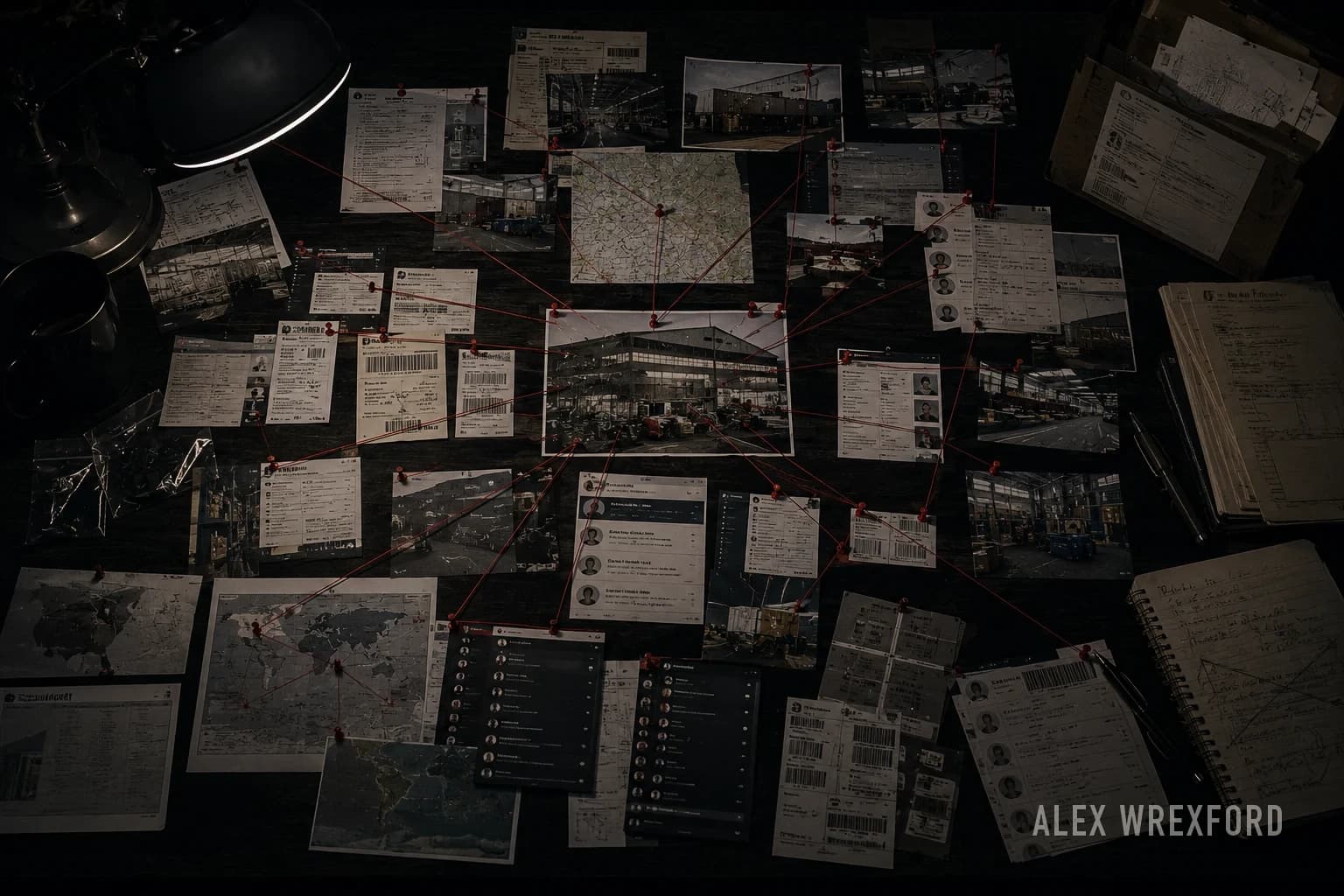
This is why counterfeiting is an attribution problem, not a volume one. Finding fakes is trivial; they're adverts, they want to be found. The hard part, the part almost nobody does because it produces a count of zero for weeks, is connecting the visible fake to the human who profits from it, then using the law to make him pay. A single test buy starts unravelling a network. A hundred storefronts collapse into one operator once you read the shipping data, the reused images, the registration fingerprints. Following the money to the payment processor does more damage in one move than ten thousand takedowns. And a Schedule A action lets a brand sue hundreds of anonymous sellers at once, freeze their accounts before they know they've been sued, and recover the money.
That's what catching someone looks like. Not a number on a dashboard. A name on a court filing, a frozen account, and a counterfeiter who, for the first time, has a reason to stop.
Common questions
Do takedowns ever make sense? As a first-pass triage tool, automation that flags suspects across millions of listings has its place. No human team reads a hundred million notices. The mistake is treating removal as the goal rather than the start.
Isn't faster detection the answer? No. Detection was never the bottleneck. Fakes are adverts, trivially findable. Faster detection just lets you find fakes quicker, file notices quicker, and watch them come back quicker, with a more expensive mallet and the same number of moles.
What about the appeal process for wrongly suppressed sellers? An appeal you fight blind, after the damage is done, against an unexplained verdict, isn't the same as a person looking before the trigger is pulled. By the time it lands, the peak season's over and the reviews have set. A pardon issued after the execution is paperwork, not justice.
This is the argument at the heart of my book, The Takedown: stop counting takedowns, start catching people.
Key takeaways
- A takedown removes a web page, not a person. The seller keeps the inventory, supplier, payment processor and intent.
- Counterfeiters spend pennies relisting while brands spend pounds finding, filing and removing. That asymmetry is built to make you lose.
- Listings removed measures the size of the problem, not your success against it. A rising number often means you are losing faster.
- Automated enforcement frequently hits the wrong target. The Urban et al. study found 28.4% of takedown notices raised a validity question and 4.2% targeted the wrong content entirely.
- Attribution and money recovery, not volume, are the only things that change a counterfeiter's behaviour.